Uyghur Historian Released From Prison
Uyghur historian Tohti Tunyaz completed his 11-year sentence for "inciting splittism" and "unlawfully obtaining state secrets" on February 10, 2009, according to information accessible to the public in the Congressional-Executive Commission on China (CECC) Political Prisoner Database, and he has since been released from prison, according to February 10 reports from the Sankei and Mainichi (via Yahoo) newspapers, based on information from sources close to the case. According to the reports, after being met by his sister at the prison in Urumqi, Xinjiang Uyghur Autonomous Region (XUAR), Tohti Tunyaz traveled to a relative's home. The Sankei report said it is unclear whether Tohti Tunyaz will be allowed to return to Japan, where he had previously lived. According to the Mainichi report, his wife and two children reside in Japan.
As noted in the CECC Political Prisoner Database, on February 11, 1998, Chinese authorities detained Tohti Tunyaz, an ethnic Uyghur citizen of China based at Tokyo University in Japan, while he was visiting the XUAR to conduct research on Uyghur history. On March 10, 1999, the Urumqi Intermediate People's Court sentenced him to 11 years’ imprisonment for "inciting splittism" and "unlawfully supplying state secrets to entities outside China," crimes under Articles 103 and 111 of the Criminal Law. On February 15, 2000, the Xinjiang High People's Court rejected his appeal, but it changed the charge of "unlawfully supplying state secrets" to foreign entities to the charge of "unlawfully obtaining state secrets," a crime under Article 282 of the Criminal Law. Sources close to the case said the alleged "state secrets" were a list of documents from an official librarian and sources said that Tohti Tunyaz had not published a separatist book, though the trial court alleged he had. On May 17, 2001, the UN Working Group on Arbitrary Detention found his imprisonment to be arbitrary and in violation of his right to freedom of thought, expression, and opinion (decision via University of Minnesota Human Rights Library). Tohti Tunyaz served his sentence in the Xinjiang Number 3 Prison in Urumqi.
Authorities in the XUAR continue to hold other Uyghurs in detention for exercising their right to free expression, based on information accessible to the public in the CECC Political Prisoner Database. Cases include:
* Miradil Yasin and Mutellip Téyip. Xinjiang University (XU) security staff detained Miradil (Mir'adil) Yasin and Mutellip Téyip on December 20, 2008, for distributing leaflets on campus calling on students to hold a demonstration. XU staff notified public security offices, which took the two young men into detention.
* Mehbube Ablesh. An employee in the advertising department at the Xinjiang People's Radio Station, Mehbube Ablesh was fired from her job in August 2008 and detained in apparent connection to her writings for the Internet that were critical of government policies, including "bilingual" education.
* Nurmemet Yasin. A XUAR court sentenced writer Nurmemet (Nurmuhemmet) Yasin to 10 years in prison in 2005 for "inciting splittism'' after he wrote a story about a caged bird who commits suicide rather than live without freedom. Korash Huseyin, chief editor of the journal that published Nurmemet Yasin's story, received a three-year sentence in 2005 for "dereliction of duty." Korash Huseyin completed his sentence in February 2008 and is presumed to have been released from prison.
* Abdulla Jamal. Authorities arrested teacher Abdulla Jamal in April 2005, after he submitted for publication a manuscript that authorities claimed incited separatism. The arrest followed his detention a month earlier, along with the detention of 3 other teachers and 17 or 18 students, ostensibly for involvement in a fight between ethnic Uyghur and Han Chinese students.
* Abdulghani Memetemin. A XUAR court sentenced journalist Abdulghani Memetemin to nine years' imprisonment in 2003 for providing information on government repression against Uyghurs to an overseas organization that reports on human rights abuses in the XUAR. Authorities characterized this act as "supplying state secrets to an organization outside the country."
The CECC reported in its 2008 Annual Report that repression in the XUAR increased in 2008 amid preparations for the 2008 Beijing Summer Olympic Games, limited official reports of terrorist activity, and protests among Uyghurs and Tibetans in China. Authorities implemented harsh security measures, especially among the ethnic Uyghur population, including wide-scale detentions, inspections of households, restrictions on Uyghurs' domestic and international travel, restrictions on peaceful protest, and increased controls over religious activity and religious practitioners. The government also continued to strengthen policies aimed at diluting Uyghur ethnic identity and promoting assimilation. Since publishing its 2008 Annual Report, the CECC has observed a continuation of harsh security measures and policies that place assimilation pressures on ethnic minorities.
For additional information about conditions in the XUAR, see the CECC 2008 Annual Report.
Tuesday, February 10, 2009

Chinese authorities offer a jailed Uyghur scholar and his wife jobs if they will stay in China.

Jailed Uyghur Scholar Offered Job
2009-02-10
Chinese authorities offer a jailed Uyghur scholar and his wife jobs if they will stay in China.
Courtesy of Rabiye Tohti
Undated photo of Tohti Tunyaz.
HONG KONG—The Japan-based wife of an ethnic Uyghur researcher thought to have been freed Tuesday after serving 11 years in prison says that Chinese authorities offered her and her husband well-paying jobs to remain in China.
Rabiye Tohti, 45 and a naturalized Japanese citizen, said in an interview that several of her husband’s professors and a number of journalists had travelled from Japan to Prison No. 3 in Urumqi, in China’s northwesternmost province of Xinjiang, to greet Tohti Tunyaz upon his release on Feb. 10.
“They waited all night but when they went to ask where he was, the authorities said he had already left,” Tohti said. She hadn’t yet spoken with him, she said.
“Even if he has been freed, he’s not totally free. He cannot go anywhere he wants. He might be forced to praise the government and the [Communist] party,” she said.
“Three months ago, the authorities asked me many times to come back from Japan. They promised a well-paying job to my husband. They told me they would give me a well-paying job too. ‘Your life in Japan is very difficult—you should come back,’ they said. ‘If you come back you will have a very good life—you will be with your relatives and have a very good life.’”
Scholar of Uyghur culture
Tunyaz, 49, was born in Bay county of Aksu prefecture, in the southern part of the Xinjiang Uyghur Autonomous Region. He graduated from university in Beijing and went on to pursue a doctorate in Uyghur culture at Tokyo University.
Chinese authorities arrested him in 1998 after he copied a list of historical documents at a public records office in Xinjiang. He was handed an 11-year jail term for allegedly endangering state security.
Tohti, who obtained Japanese citizenship last week, said she had sought permission to bring her husband to Japan for medical treatment, citing a foot injury resulting from a car accident. She said she had travelled to Urumqi twice to see her husband in 1998 but wasn’t allowed to visit him.
Prison officials, contacted by telephone during and after working hours, declined to comment.
The Yomiuri Shimbun newspaper quoted a spokesman for Tokyo University as saying, “If he's willing to return to his studies, the door's open."
The spokesman said the university renews Tunyaz's temporary leave status every year, and a new instructor was assigned for him after his previous teacher retired.
Uyghurs, who are mostly Muslim, constitute a distinct ethnic minority in Xinjiang. Chinese authorities have accused some Uyghurs of conducting terrorist violence in recent years.
In its 2008 annual report, the Congressional Executive Commission on China reported that "human rights abuses in the Xinjiang Uyghur Autonomous Region remain severe, and repression increased in the past year... [The] government uses anti-terrorism campaigns as a pretext for enforcing repressive security measures and for controlling expressions of religious and ethnic identity...."
In 2007, it said, the head of the Xinjiang High People’s Court said that the region bears an ‘‘extremely strenuous’’ caseload for crimes involving endangering state security. Chinese media reported that courts in the region would ‘‘regard ensuring [state] security and social stability [as] their primary task."
Original reporting by Akida for RFA’s Uyghur service. Translated by Uyghur service director Dolkun Kamberi. Written and produced in English by Sarah Jackson-Han.
Source
Wednesday, September 03, 2008

The Honourable Jason Kenney
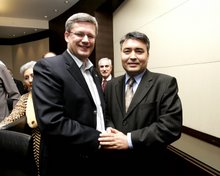
Jason Kenney hosts a private lunch for Rebiya Kadeer, President of the World Uighur Congress. He later arranged for her to come to the lobby of the House of Commons to meet with Ministers. From left to right: Secretary of State Kenney, Rebiya Kadeer, Mehmet Tohti of the Uighur Canadian Association, and Michael Mostyn of B'nai Brith Canada.
Jason Kenney hosts a private lunch for Rebiya Kadeer, President of the World Uighur Congress. He later arranged for her to come to the lobby of the House of Commons to meet with Ministers. From left to right: Secretary of State Kenney, Rebiya Kadeer, Mehmet Tohti of the Uighur Canadian Association, and Michael Mostyn of B'nai Brith Canada.
http://www.canadianheritage.gc.ca/pc-ch/min/kenney/photos/2008-06-12_e.cfm
Minister Kenney supports Rebiya Kadeer
June 13, 2008
Jason Kenney hosted a private lunch for Rebiya Kadeer (President, World Uyghur Congress), and subsequently arranged for her to come to the lobby of the House of Commons to meet with other government ministers, to draw attention to the case of Huseyin Celil, a Canadian citizen imprisoned in China, as well as the persecution of the Uyghur people.
Also pictures are Mehmet Tohti of the Uighur Canadian Association, and Michael Mostyn of Bnai Brith Canada. Prime Minister Harper met with Ms. Kadeer during her first visit to Canada two years ago.
source
Quiet diplomacy fails Canadians
Quiet diplomacy fails Canadians
May 26, 2008
The Canadian government likes to claim that it cares about citizens who are in trouble in foreign lands.
In fact, Canada's record of assisting citizens in trouble is abysmal -- a record that stretches over the years, be it Liberal or Conservative governments.
Last week, to its credit, the Globe and Mail front paged news about a couple of Canadians in trouble, one of which the Sun has agitated about, the other of which had largely been ignored.
The first case is Huseyin Celil, a native Uighur from China who became a Canadian citizen and was arrested for no apparent reason while visiting relatives in Uzbekistan. Although he travelled on a Canadian passport, Canadian authorities were not interested in rescuing him from the Uzbeks, who were acting on behalf of Beijing, which wanted the guy back.
It was only after publicity, and after he was secretly sentenced in 2007 to life imprisonment, that the government began pressuring Beijing.
"Pressuring" is being generous. Canada seems to accept Beijing's view that Celil is a "terrorist," even while not believing it. Our national fixation on not making waves makes us diplomatic eunuchs.
Maybe Celil will be freed to return to Canada after the Olympics. Yeah, that's what they always say: Jam yesterday, jam tomorrow, never jam today.
The other case is more savage -- Mohamed Kohail, who was attending school in Saudi Arabia, is to be beheaded, along with a Jordanian, while his 17-year-old brother Sultan Kohail has been sentenced to 200 lashes.
Their crime -- the death of a member of a Saudi gang of a dozen teenagers who were chasing the three, got into a scrap, and a stone gate collapsed on a gang member. An autopsy showed no broken bones, no cuts, but internal bleeding and a weak heart.
Canada's reaction? An appeal to the Saudis for clemency. If clemency is given, the Saudis will be praised for humanitarianism.
SAMPSON AND SAUDIS
It's mindful of the government's shameful behaviour when Bill Sampson was framed by the Saudis for murder, tortured and condemned to death. Canadian MPs who visited him chained to a hospital bed, said nothing because the believed in "quiet diplomacy."
Sampson identified his torturers, but the government preferred to believe the Saudi ambassador's insistence that Saudis don't torture. Sampson was released after 31 months, but is still angry at his treatment, still totally innocent. Meanwhile, Canada views Saudi Arabia as an ally.
Turn the clock back. In the 1970s David Somerville was arrested in Tanzania with the Canadian government doing nothing on his behalf. When he was eventually released, Mitchell Sharp, who was then external affairs minister, claimed credit and quoted Somerville's gratitude -- which was news to Somerville, who by then was a Toronto Sun reporter and refuted Sharp's claims.
Recently Brenda Martin returned to Canada after two years of awaiting trial in Mexico, always proclaiming her innocence.
Media attention persuaded government to act.
Without publicity, Canada does little for citizens in trouble.
And I refer to innocent citizens, not obvious law-breakers or criminals -- not the likes of Omar Khadr, quickly becoming a media darling because at age 15 he was with the Taliban in Afghanistan and is charged with killing an American soldier. He's now 21 and in his sixth year held at Guantanamo Bay.
Khadr gets oodles of sympathy from the likes of the CBC, but there's relative silence about Celil and Uighurs, whom the Chinese view as terrorists as they do the Dalai Lama and Tibetans.
Quiet diplomacy be damned. Ottawa should raise hell when citizens are abused.
http://www.edmontonsun.com/Comment/2008/05/26/5667931-sun.html
Subscribe to:
Posts (Atom)